
Blockchain versus Distributed Ledgers (DLT)
Blockchain is merely one specific type of distributed ledger technology (DLT). DLT is a decentralised database of records distributed among multiple participants or across locations, which requires node validation for making changes to the ledger. They are used for data exchanges such as transaction processing, validation, and authentication. All files receive a unique cryptographic signature and are timestamped once consensus is reached by participants on the network. The differentiating factors between blockchain versus DLT are frequently overlooked.
Blockchain versus DLT
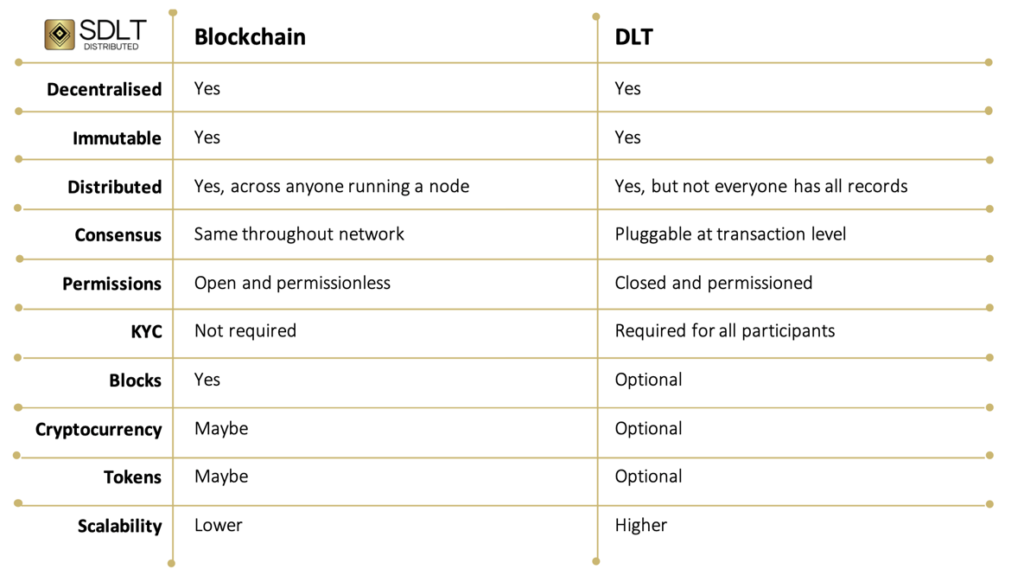
A common misconception is that blockchain and distributed ledger technology are one and the same. The former (blockchain) is actually a type of the latter (DLT) which, because of its popularity, has become ingrained in people’s minds as what the product is. Think of blockchain and distributed ledger in the same way one might think of Post-it and sticky notes. In the same way not all sticky notes are Post-it, not all DLTs are blockchains – but all blockchains are DLTs.
The transactional architecture of blockchain bundles validated transactions into a sequential chain of time-stamped, cryptographically hashed blocks that are globally available to all parties on the network. By contrast, transactions on a standard DLT ledger are only available to included parties and data does not need to be structured in blocks or require a sequential chain. DLTs may also simply be a distributed system of record (SoR), without facilitating financial exchanges through a form of cryptocurrency as is common with a blockchain. The similarities and differences of blockchain versus DLT are summarised in the table below.
ECB Launches Appia Roadmap for European Digital Asset Ecosys | Phemex News
News ECB Unveils Appia Roadmap for Unified European Digital Asset Ecosystem by 2028 ECB Unveils Appia Roadmap for Unified European Digital Asset Ecosystem by 2028 The European Central Bank (ECB) has announced the Appia roadmap, aiming to unify Europe's fragmented tokenized capital markets by 2028. ECB Executive Board Member Piero Cipollone outlined the initiative during
Stablecoins: solving the USD 120 bln liquidity trap | The Paypers
PhotonPay elaborates on how stablecoin rails are delivering real-time settlement, lower costs, and deterministic finality – and redefining cross-border payments. In a digital economy that operates around the clock, the financial rails underpinning global trade continue to lag behind. The core friction is structural. The correspondent banking model resembles a serial relay race: funds must pass
ECB reveals Appia roadmap for central bank money in Europe’s tokenized markets
The European Central Bank (ECB) on Wednesday published its Appia roadmap, setting out a long-term plan for building tokenized wholesale financial markets in Europe anchored in central bank money. The roadmap is built around two linked initiatives. Pontes is the Eurosystem’s distributed ledger technology settlement solution, while Appia is the broader strategic framework for developing


