
BIS-led Prototypes Disclosed
KB, Shinhan, Hana, Woori, NH, IBK, etc. Participation in 6 places
Real-time simultaneous payment based on tokenization
Establishment of integrated heads of central banks and commercial banks
![Comparison of payment schemes (left) with traditional cross-border payment schemes (right) with Agora Project prototypes. [Picture =BIS]](https://wimg.mk.co.kr/news/cms/202605/28/news-p.v1.20260528.84f0f1c8f9054a5a9fa43859cbbe3551_P1.jpg)
The prototype of the cross-border wholesale payment platform “Project Agorá,” which has been developed by 40 central banks and private banks in seven countries, including the Bank of Korea, for two years, was first unveiled under the leadership of the Bank for International Settlements (BIS).
On the 27th (local time), the BIS and the International Financial Association (IIF) announced that they would publish a report on the results of “Project Agora” and pursue transaction tests using actual funds for some currencies and participating institutions in the future. In addition, it will expand the role of the private sector and recruit additional new participating organizations.
Project Agora is a large-scale public-private partnership project that aims to tokenize the deposits of commercial banks and the payment reserves of central banks to integrate and operate them on a single programmable platform.
In addition to the Bank of Korea, central banks in seven major countries, including the Federal Reserve Bank of New York, the Bank of England, the Bank of France (representative of the Eurosystem), the Bank of Japan, the Bank of Mexico, and the National Bank of Switzerland, and more than 40 private financial institutions participated in the project Agora. On this day, the BIS also announced that it would additionally join the Central Bank of Canada.
In the domestic banking sector, six companies, including KB Kookmin Bank, Shinhan Bank, Hana Bank, Woori Bank, NH Nonghyup Bank and IBK Industrial Bank, were listed on the list of participating financial institutions. Overseas, large global banks such as JPMorgan Chase, UBS, Deutsche Bank, HSBC, BNP Paribas, Citi, Standard Chartered, Mizuho Bank and MUFG, as well as international payment networks such as Mastercard, Visa, Swift and Euroclear, participated.

Today’s cross-border payments rely on a Correspondent banking structure that requires several intermediaries to go through sequentially, which has the chronic problem of slow speed, high cost, and poor transparency.
According to BIS, cross-border payments are expected to reach $195 trillion in 2024 and increase to $320 trillion by 2032.
Nevertheless, the old cross-border payment and settlement structure has been pointed out as bottlenecks that hinder global trade and economic growth, including inconsistencies in operating time of each country’s payment systems, poor data quality, and liquidity tied due to sequential fund processing.
To overcome this inefficiency, the Agora project presented an architecture utilizing distributed ledger technology (DLT) and smart contracts.
The system was designed with two hierarchical structures: Unifying Ledger, where tokenized deposits of commercial banks are recorded, and Jurisdiction Ledger, where tokenized payment reserves of central banks of each country are recorded.
This allows central banks in each country to enjoy the benefits of a single, interoperable platform while maintaining autonomy and control over national currencies and operations.

The most important innovation of the Agora prototype is the implementation of ‘Atomic Settlement’.
In the existing system, the exchange of payment information and the movement of funds were segmented and occurred sequentially, so if an error occurred in the middle of the transaction, there was a credit and payment risk that the funds had to be collected again.
On the other hand, the Agora project adopted a method of coordinating payment-related information and compliance approval before locking the funds.
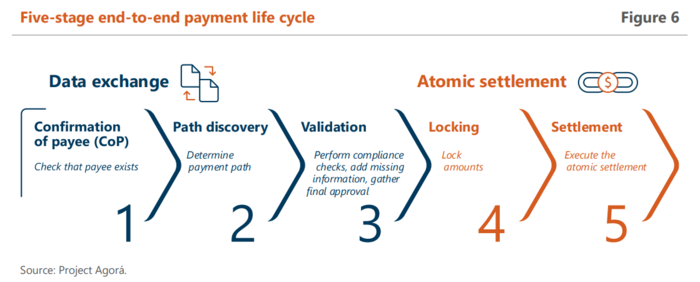
The payment process follows a five-step end-to-end (E2E) life cycle of validation, including confirmation of payee, path discovery, anti-money laundering (AML) and sanctions review, locking, and settlement.
Only when all conditions are met through this process will payments across multiple currencies and jurisdictions be executed simultaneously in an “all-or-nothing” manner, essentially blocking payment risk
The core of this structure is that, unlike the existing cross-border payments that processed “information” and “money movement” sequentially, the funds are moved only after the information processing is completed first by separating the two. The cost of reversing the transaction may be reduced after a payment failure.
“If all the information necessary for the transaction is confirmed in advance, all the relevant balances will be paid in batches at once,” BIS Vice President Andrea Mackler explained.

The biggest feature that distinguishes the Agora prototype from the blockchain payments of the private stablecoin camp is that it maintains the existing corresponding banking system.
BIS reaffirmed its currency trading bank as “the basis of global payments.” Agora was designed to preserve the existing sanctions review and anti-money laundering system.
Project Agora has also provided technical safeguards for privacy protection and regulatory compliance, which are core values of the financial sector.
The prototype applies a privacy framework called “Paladin” to encrypt token balance and transaction information. Each institution can only view information on the payment stage in which it is involved, and only the minimum amount of proof data is recorded on the shared ledger.
The system combines the Noto token privacy model and the Pente workflow privacy technology to protect the data multilayered. Transaction balances or sensitive customer information are not directly exposed to the ledger, only encrypted identifiers and approval results are recorded.
Each private financial institution independently performs anti-money laundering and sanctions screening on its internal systems and shares only the results to fully protect data privacy and meet regulatory compliance requirements at the platform level. It proved that a reliable payment network can be built without centralized data sharing.

The review of legal feasibility is also one of the important achievements of the project agora.
BIS confirmed that tokenized payment reserves and deposits issued on the Agora platform have the same legal characteristics as traditional account-based currencies.
The report said the technological change of tokenization does not fundamentally change the legal nature or related obligations of money and can achieve “settlement finality” within the existing legal framework in all seven jurisdictions that participated.
However, future commercialization should be accompanied by additional work that details technical, operational, and contractual requirements that best fit each country’s legal system, the report noted.
There are still a number of tasks to be solved for commercialization. The report listed cybersecurity, operational resilience, processing performance, interworking with existing real-time total payment systems (RTGS), and compliance with country-specific data localization regulations as future improvements.
In particular, Korea has regulations prohibiting the overseas storage of personal credit information and unique identification information, so data governance design is expected to be an important variable when domestic institutions expand their participation.
In the case of the Bank of Korea, the Agora Project and the domestic “Project Han River” are likely to become the two pillars of digital currency policy under the new governor Shin Hyun-song, a former BIS economic adviser and director of the monetary economy bureau.
Some predict that Governor Shin will be active in deepening the project as he directly contributed to the formation of the concept of an “integrated director” while serving at BIS.

