Scaling SMS for the DLT Era: The Spring Edge Approach to Business Communication
The landscape of business communication in India has been redrawn over the last five years. Once a freewheeling channel, bulk SMS, in 2021 it became one of the most regulated messaging environments in the world. The Telecom Regulatory Authority of India’s (TRAI) Distributed Ledger Technology (DLT) framework, now governs how every commercial SMS reaches an Indian mobile number. For the more than 30,000 enterprises registered on operator DLT portals, this has meant rebuilding messaging infrastructure from the ground up and rethinking what “scale” actually means in a compliance-first market.
The DLT Shift: From Volume to Trust
DLT was introduced to curb the unsolicited-message problem that had defined Indian telecom for years. But the regulation did more than block spam. It restructured the entire A2P (application-to-person) messaging stack. Every commercial sender must now be a registered entity on Jio, Airtel, Vi, and BSNL DLT platforms. Every sender ID (header) must be operator-approved. And every message body whether a one-time password, an order confirmation, a transactional SMS, or a bulk SMS marketing offer must match a pre-scrubbed template.
The shift from volume to trust has been measurable. Industry estimates put A2P SMS volume in India at over 10 billion messages per month, of which roughly 70% is transactional SMS and OTP authentication traffic. The aggregator model that dominated pre-DLT where senders had little visibility into compliance posture has given way to direct, auditable communication trails between enterprise, SMS API platform, and operator.
Scaling SMS in a Regulated Environment
In this new environment, an SMS API is no longer just a delivery pipe. It acts as a compliance engine, routing layer, and observability system combined.
The complexity increases for enterprises operating across India’s 22 telecom circles, each with unique traffic patterns and operator dependencies. Managing DLT registration, template approvals, and delivery optimization across multiple operators can significantly slow down product rollouts.
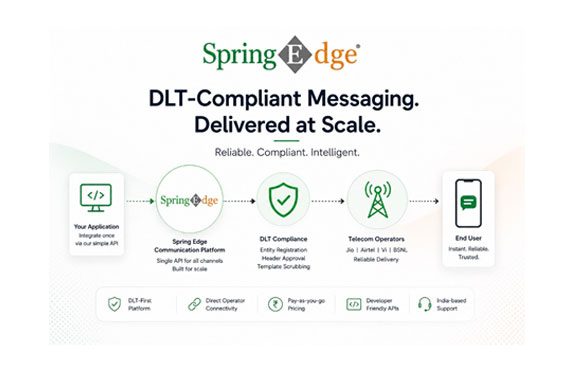
Transactional SMS API Platform Spring Edge addresses this challenge by embedding compliance into the messaging workflow. From DLT entity registration and sender ID approval to template scrubbing across operators, the process is streamlined through a single API. What previously took 1–2 weeks can now be completed within 24–48 hours, enabling faster go-to-market for messaging-enabled applications.
Beyond SMS: The Rise of Business Communication
While SMS remains the most reliable channel for time-sensitive communication, user behavior in India has evolved toward multi-channel engagement.
Customers today interact across:
-
SMS for OTPs and critical alerts
-
WhatsApp for confirmations and support
-
RCS for branded, interactive messaging
-
Voice for fallback and high-priority notifications
A typical transaction might involve an OTP via SMS, a confirmation on WhatsApp Business API, and a follow-up voice alert, all within minutes.
This shift is driving the need for channel orchestration, where businesses intelligently select the best communication channel based on urgency, user preference, and message type.
A Platform-Centric Approach to Communication
A platform-centric approach replaces those silos with a single integration that covers SMS, RCS and voice channels under one DLT entity and one set of webhooks.
Spring Edge is one of the SMS API platforms purpose-built for this consolidation. Headquartered in Bangalore and serving Indian enterprises since 2014, Spring Edge runs SMS, WhatsApp Business, Voice Broadcasting, and RCS through the API surface, so a fintech that needs OTP SMS, transactional WhatsApp, and Voice, and one set of delivery webhooks.
Pay-as-you-go pricing removes the FX exposure that catches billing through global CPaaS providers, and India-based engineering support means operator-side issues like sender ID rejection, SMS template scrubbing failures, or circle-level delivery degradation get resolved in hours, not days. For Indian startups that need a developer-friendly SMS API with no monthly minimums and free trial credits, the consolidation is structural.
Intelligence and Automation in Messaging
The next frontier is what happens after the message is sent. Delivery reports were once a nice-to-have; in the DLT era, they are operational telemetry. This data feedback loop is what separates SMS providers that simply send messages from platforms that operate a communication layer.
The Spring Edge SMS API illustrates the difference: every send, scrub, and delivery report flows through a single observable pipeline, with sub-3-second OTP delivery on direct operator routes, real-time webhooks for status changes, and per-operator failure attribution surfaced back to the application layer.
The DLT Compliance Stack for SMS
For teams asking the question every Indian developer eventually asks, what does it actually take to send DLT-compliant SMS in India? the answer breaks into three layers:
1.Entity and header registration on operator’s DLT portal, One-time setup for SMS header / sender ID approval.
2.Template scrubbing: every variation of transactional or promotional message body must be approved and bound to a specific SMS Header.
3. API Integration A robust SMS API ensures that only compliant templates are used, routes messages efficiently, and provides delivery feedback.
A fully managed Spring Edge SMS API integration handles all three layers from DLT registration support through ongoing template lifecycle management so engineering teams can ship messaging features in days rather than spending sprints navigating regulator portals.
The Road Ahead for A2P Messaging in India
The future of business communication in India will not be defined by the number of messages sent, but by the quality, trust, and intelligence behind each interaction.
In this context, India-native platforms built around DLT compliance, such as Spring Edge, are playing a key role in enabling scalable and reliable messaging. By combining regulatory alignment with multi-channel capabilities and real-time intelligence, these platforms are helping businesses navigate the complexity of modern communication.
Ultimately, in the DLT era, the real question is no longer how many messages can be sent, but how effectively each message builds trust when it reaches the end user.

