
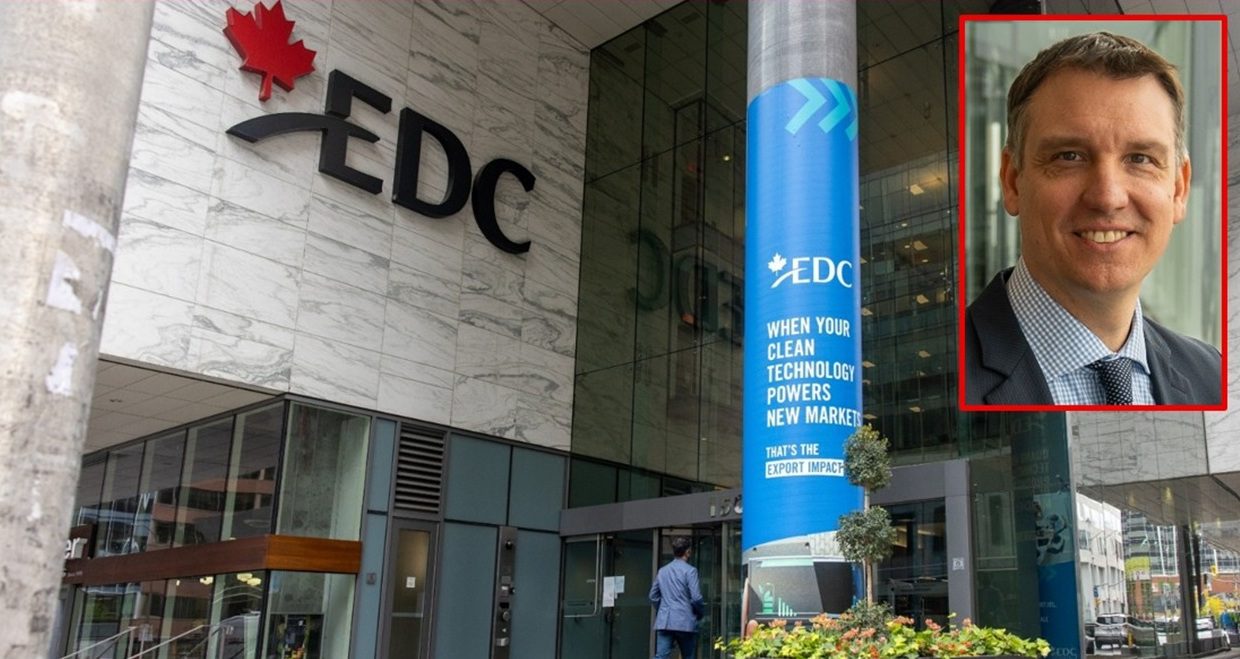
Canadian Gov’s export credit agency issues first tokenised bond

Canada’s export credit agency has issued the country’s first tokenised bond using distributed-ledged technology (DLT).
The pioneering issuance serves as the latest example in a global trend towards using DLT for bond issuances, with the wider collaboration surrounding the initiative being hailed by a member of the country’s central bank’s executive council as “showing how the public sector and industry can work together to harness innovation in the payment ecosystem.”
Ottawa-headquartered Export Development Canada (EDC), which exists to help Canadian businesses to trade internationally, collaborated with the Bank of Canada and two Toronto-headquartered commercial banks, Royal Bank of Canada (RBC) and TD, to ‘evaluate how tokenisation and DLT can improve bond issuance and settlement in a real-world setting,’ according to an EDC announcement (5 March).
The project was structured as what is described as a ‘limited experiment’, involving the issuance of a single security – a $100 million (about £55m/USD$74m) Canadian dollar-denominated bond of less than three months – to a closed investor group. Payments were settled in wholesale central bank central bank digital currency (CBDC) issued by the Bank of Canada specifically for this transaction
The issuance comes hot on the heels of developments elsewhere across the globe, including the Bank of Greece undertaking a simulated issuance of a sovereign digital bond on a distributed-ledger platform; and, in the UK, HM Treasury announcing the selection of HSBC to provide the platform for the UK Government’s first blockchain bond issuance.
*** RECEIVE GLOBAL GOVERNMENT FINANCE’S FREE EDITORIAL NEWSLETTER ***
Project Samara detail
The initiative – dubbed ‘Project Samara’ (and detailed in a 45-page ‘Project Samara Research Paper’) – built on experimental work from the series of ‘Jasper’ projects, which have a history stretching back a decade.
‘Project Jasper’ was a collaborative research initiative launched in 2016 involving the Bank of Canada, Payments Canada (which is responsible for Canada’s payment clearing and settlement infrastructure), DLT provider R3, professional services giant Accenture and commercial banks to explore how DLT, or blockchain, could transform wholesale interbank payments. It progressed through multiple phases and into cross-border experimentation.
The bond was sold and traded and will be managed throughout its lifecycle on the RBC-managed Samara Platform.
‘The Samara Platform was designed for the experiment to support end-to-end transactions throughout the bond’s lifecycle – including cash and bond issuance, bidding, coupon payment, redemption and secondary trading – on DLT infrastructure,’ the EDC announcement (5 March) states.
The platform was built on Hyperledger Fabric (a blockchain framework that is part of the Hyperledger project hosted by the Linux Foundation). It integrates separate bond and cash ledgers and enables the transaction to be settled instantly, as well as secondary market trading and settlement of the tokenised bond, directly on the blockchain (‘on chain’), the announcement explains.
Global Government Finance’s Blockchain topic section
DLT’s potential and limitations
Both the potential and limitations of DLT in a real-world financial setting were shown during the experimentation, the parties involved conclude.
In respect of efficiency gains, both operational efficiency and data integrity were improved, and workflows were streamlined. However, efficiency gains were ‘partially offset by system complexity, liquidity costs, the need for new governance structures, and increased attention in coordination, reporting and oversight’, it states.
In respect of risk management, counterparty and settlement risk were reduce, but new operational risks related to technology, auditability and fallback mechanisms were introduced.
On regulatory and legal considerations, some centralised roles (such as a marketplace operator, custodian and off-platform trade reporting) ‘highlighted gaps between the current regulatory framework and DLT principles,’ the announcement states.
The announcement notes that despite technical feasibility, broader adoption ‘will likely be slow due to several factors, such as integration challenges and limited appetite for core infrastructure changes’.
Overall, those involved conclude that the project ‘generated valuable insights into the practical application of DLT in capital markets’ and that the insights ‘provide a foundation for future work’.
‘While impacts in the short term are uncertain, the technology appears well-positioned to deliver efficiency and resilience benefits over the long term,’ they add.
*** JOIN GLOBAL GOVERNMENT FINANCE ON LINKEDIN ***
‘Efficiency and security’
“Issuing Canada’s first tokenised bond is an exciting milestone for EDC and Canada,” said Scott Moore, executive vice-president – finance and chief operating officer at EDC, in the announcement.
“As Canada’s export credit agency and an institution active in international capital markets, EDC is proud to contribute to this innovation alongside trusted partners,” he continued. “The execution of Project Samara marks an important step in deepening our understanding of tokenisation and distributed-ledger technology and how it can contribute to the efficiency and security of financial instruments to better serve investors, businesses and the financial community.”
“Project Samara shows how the public sector and industry can work together to harness innovation in the payment ecosystem,” said Bank of Canada’s executive director for payments, supervision and oversight, Ron Morrow
“The Bank welcomes further collaboration in this fast-developing area and will continue to play a role as enabler of innovation in payments that serve Canadians,” he added.
RBC and TD, which were joint lead managers, both participated in Project Jasper, as well as in the issuance of the world’s first blockchain bond – ‘bond-i’ (‘blockchain operated new debt instrument’) –by the Washington DC-headquartered World Bank in 2018. Both RBC and TD were involved in a tap issue of bond-i in 2019 (a ‘tap issue’ is an issuance of additional bonds from an already existing issue).
FURTHER READING Government bond tokenisation market ‘gaining momentum’: BIS analysis – a news article (15 July 2025) on a paper published as part of the ‘BIS Bulletin’ series (see below)
Bond tokenisation’s ‘momentum’
The case for tokenised government bonds was analysed in a Bank for International Settlements (BIS) paper published in July last year.
With a total value estimated at $80 trillion (about £59 trillion), government debt comprises the ‘largest and most critical global asset market, and a cornerstone of the financial system’, the eight-page analysis – titled ‘Tokenisation of government bonds: assessment and roadmap’ – noted. Government bond markets similarly ‘serve as a critical source of financing for governments, a trusted savings vehicle for households and businesses and the key locus of central banks’ monetary policy operations.’
Bond tokenisation ‘remains in its early stages but has gained momentum in recent years among both corporates and governments’, the authors wrote, stating that, at their time of writing, more than 60 tokenised bonds have been issued, amounting to a total value of $8 billion.
Supranational institutions, such as the European Investment Bank (EIB), World Bank and the Inter-American Development Bank (IDB) have been ‘particularly active’ in this space, a three-page ‘online annex’ to the paper detailed. It added that, treasuries and central banks in regions such as Southeast Asia and Europe have also issued tokenised bonds, ‘showcasing their potential’ for broader adoption.’
‘Notably, local and municipal entities, such as Swiss cantons and one US municipality [Quincy], have also issued tokenised bonds, underscoring the increasing interest from smaller jurisdictions,’ it continued. ‘This diversity of issuers and practices reflects the early experimental stage of tokenised bond markets as well as the fast-growing interest in these instruments.’

