CBUAE launches due diligence platform for individuals and businesses

The launch of a nationwide ‘unified’ due diligence platform based on distributed-ledger technology (DLT) has been announced today (15 April) by the Central Bank of the United Arab Emirates (CBUAE).
The know-your-customer (KYC) and know-your-business (KYB) platform, developed by Sweden-headquartered technology company Norbloc, began life more than six years ago as a Dubai government-backed for the exchange of verified KYC data between licensing authorities and financial institutions (Dubai is one of the UAE’s seven emirates). Its evolution is being trumpeted by the central bank as representing a ‘key milestone in the digital transformation of the UAE’s financial sector.’
Norbloc’s technology has, since 2020, powered a Dubai Department of Economy & Tourism-supported e-KYC network used by banks such as Emirates NBD, Commercial Bank of Dubai, Abu Dhabi Commercial Bank (ADCB), HSBC, First Abu Dhabi Bank (FAB) and Ahu Dhabi Islamic Bank (ADIB). Licensing authorities using the system have included Dubai International Financial Centre (DIFC) and Ras Al Khaimah Economic Zone (RAKEZ).
The CBUAE is now working alongside Norbloc to operate the platform as a national system covering individuals as well as companies. Participation for all financial institutions regulated in the UAE is to become mandatory.
The central bank says the initiative constitutes a core pillar of its ‘Financial Infrastructure Transformation (FIT) Programme’, instigated in 2023 as part of a strategy to ‘accelerate the digital transformation’ of financial services.
RELATED ARTICLE UAE ‘Financial Infrastructure Transformation Programme’ is ‘85 per cent’ complete – a news story (31 January 2025) on FIT
‘Unified national approach’
The new platform will ‘enhance the efficiency of KYC/KYB processes, as well as due diligence requirements through automated workflows and the integration of trusted data sources,’ the CBAUE states in a press announcement, adding that it will ‘strengthen compliance and ensure alignment with’ anti-money laundering and combatting the financing of terrorism (AML/CFT) frameworks.
‘Underpinned by a robust privacy-by-design technology, the platform enables secure data sharing strictly based on explicit customer consent, ensuring the highest standards of confidentiality, data protection and trust across the financial system,’ the CBUAE continues. ‘It introduces a unified national approach that supports both financial institutions and fintech companies, delivering a faster and more reliable digital onboarding experience for individuals and businesses, while substantially reducing turnaround times and operational costs.’
The platform will, the central bank explains, ‘address challenges arising from the duplication of customer due diligence processes, reduce compliance costs, and strengthen financial stability and competitiveness.’
Future phases will focus on ‘expanding the platform’s capabilities and deepening its integration with relevant stakeholders, supporting the development of an advanced and sustainable digital financial ecosystem.’
The initiative ‘underscores the CBUAE’s commitment to leveraging advanced technologies to enhance governance, deliver customer-centric financial services, support ease of doing business, and further cement the UAE’s position as a hub for innovative digital regulatory infrastructure,’ the central bank states.
‘New benchmark in digital compliance’
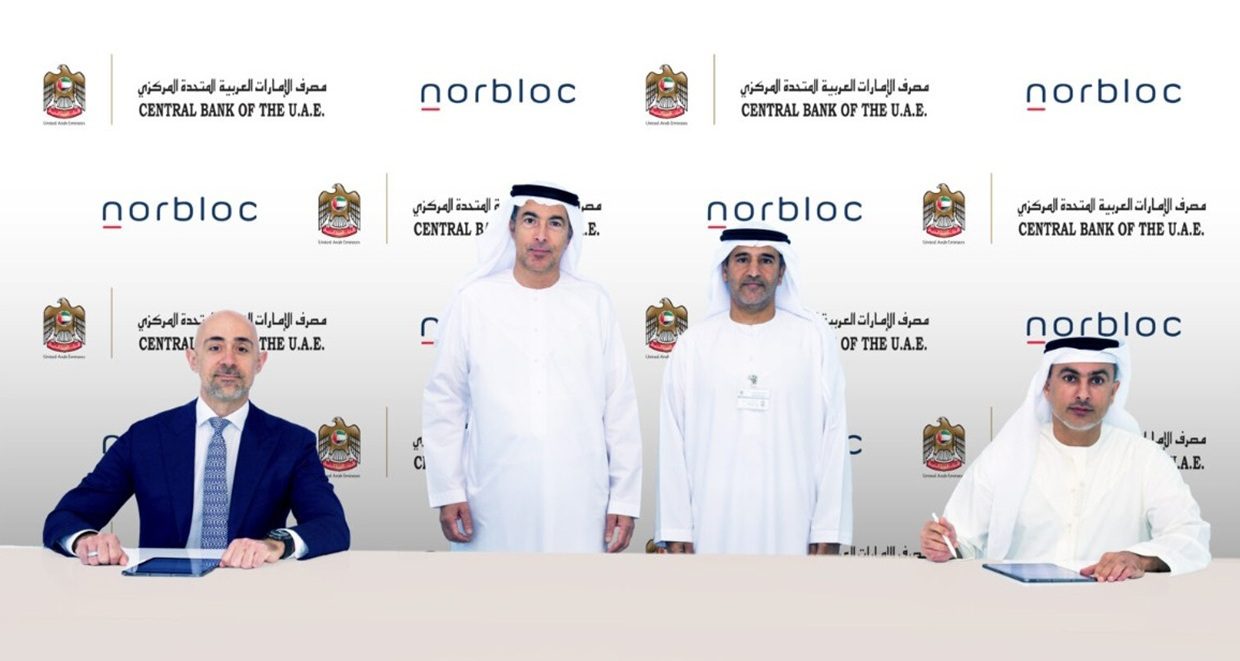
An agreement between the CBUAE and Norbloc was signed by the former’s assistant governor for banking operations and support services H.E. Saif Humaid Al Dhaheri and the latter’s chief executive Astyanax Kanakakis.
CBUAE governor H.E. Khaled Mohamed Balama and assistant governor for banking and insurance supervision H.E. Ahmed Saeed Al Qamzi attended a signing ceremony.
“The development of the e-KYC platform represents a strategic transformation towards a more efficient and resilient financial ecosystem,” said H.E. Saif Humaid Al Dhaheri in the announcement.
“Through this platform, we are enabling the sector to move away from resource-intensive traditional processes towards progressive digital models that accelerate access to financial services and reduce operational costs.”
Kanakakis described the platform as “setting a new benchmark in digital compliance globally.”
“By leveraging advanced technologies, we will enable financial institutions to access trusted and secure data in real time from multiple sources, enhancing operational efficiency while adhering to the highest international standards,” he said. “It also empowers users with full control over the management of access to their data.”
Headquartered in Sweden’s capital Stockholm, Norbloc has a development hub in Greece.
CBUAE’s tech partner for CSD
The CBUAE earlier this week announced the appointment of Vermeg as ‘lead technology partner’ in a consortium supporting the establishment of a Central Securities Depository (CSD) for national debt and sukuk (Sharia-compliant asset-based investment certificates – often called ‘Islamic bonds’).
Vermeg is a Netherlands-headquartered provider of software solutions to the financial services sector.
The establishment of a CSD is part of the central bank’s strategy to boost the infrastructure of the UAE’s capital markets – specifically, the efficiency of post-trade operations – the CBUAE said in an announcement (13 April).
“The development of a Central Securities Depository represents a key cornerstone in building a more efficient and resilient financial infrastructure, directly supporting the growth of capital markets and reinforcing the confidence of international investors in the UAE,” said H.E. Saif Humaid Al Dhaheri.
The UAE already has multiple CSDs that operate across its different financial markets. For example, Dubai Central Securities Depository (Dubai CSD) and Abu Dhabi Depository (AD CSD).

